Hackers Are Using AI. So Should You.

Introduction
Cyber attacks are no longer powered only by human skill and manual effort. Today's attackers are using artificial intelligence to move faster, scale wider, and evade detection with unprecedented precision. From AI generated phishing campaigns to automated malware that mutates in real time, the threat landscape has fundamentally changed. Cybercrime has entered the machine speed era.
Yet many organizations are still defending their environments with human speed processes. Analysts manually triage alerts. Investigations require pivoting across disconnected tools. Response actions depend on ticket queues and handoffs. This growing imbalance between attacker automation and defender workflows is one of the most dangerous gaps in modern cybersecurity.
If hackers are using AI to attack, then defenders must use AI to protect. This is no longer an innovation conversation. It is a survival conversation.
The AI Arms Race
Why traditional defenses can't keep up with AI-powered attacks
The New Battlefield
Cybersecurity has entered an AI versus AI era where machine speed determines winners
Attack Speed
What once took days now takes seconds with AI-powered phishing and malware
vs Days
AI accelerates lateral movement and data exfiltration from days to hours
Speed Gap
Traditional SOC models can't match machine-speed attacks with human-speed defenses
The Rise of AI Powered Cyber Attacks
Artificial intelligence has dramatically lowered the barrier to entry for cybercrime while increasing the sophistication of attacks. Threat actors now use AI to automate reconnaissance, identify vulnerable systems, and build realistic phishing lures that adapt to the target's behavior, industry, and role.
Malware is also evolving. AI enables rapid code mutation that helps malicious payloads evade traditional signature based detection. Attack tools can now dynamically adjust to firewall rules, endpoint defenses, and identity controls in near real time.
Once attackers gain access, AI accelerates lateral movement, privilege escalation, and data exfiltration. What once took days or weeks now takes minutes or hours.
Speed has become the attacker's greatest weapon.
Why Traditional SOC Models Are Failing
Most Security Operations Centers today are built on outdated assumptions.
First, alert volume has exploded. Cloud platforms, identity providers, endpoints, and SaaS tools generate massive amounts of telemetry. The result is constant alert fatigue. Analysts spend more time filtering noise than stopping real threats.
Second, investigations remain fragmented. Data is scattered across endpoint security, identity systems, network tools, cloud logs, and threat intelligence feeds. Analysts waste time pivoting between dashboards while attackers continue to move.
Third, talent shortages and burnout are at all time highs. Skilled defenders are leaving faster than organizations can replace them. Manual investigation at scale is no longer sustainable.
Attackers do not face these limits. AI gives them unlimited capacity. That imbalance is why breaches continue to rise even as security budgets grow.
The Asymmetric Battlefield
AI-powered attackers vs. human-constrained defenders
Attackers
AI-Powered Offense
Targeted Phishing
AI crafts personalized attacks at scale
Evasion Tactics
Polymorphic malware evades detection
Rapid Scaling
Attacks amplified across thousands of targets
Traditional SOC
Human-Speed Defense
Alert Fatigue
Analysts drowning in noise
Talent Shortage
Burnout and high turnover
Rising Costs
Budgets grow but breaches continue
AI Is No Longer Optional for Defenders
For defenders, AI is no longer a nice to have enhancement. It is a necessary foundation for modern security operations.
AI transforms the SOC by:
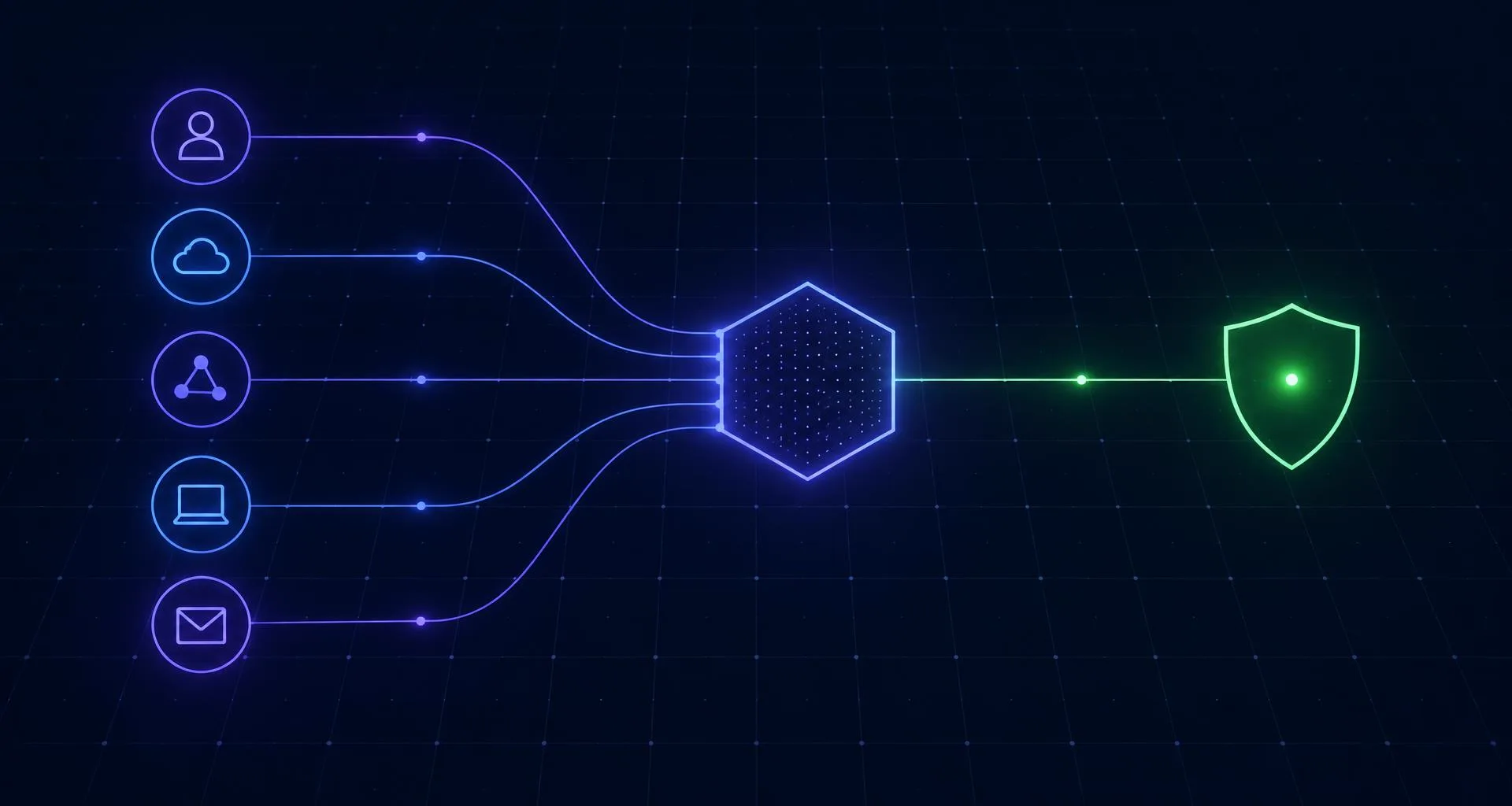
- Automating alert correlation across endpoint, identity, cloud, and network data
- Providing real time enrichment using global threat intelligence
- Identifying true risk based on behavior, not just static rules
- Triggering automated containment actions with human oversight
The result is dramatic compression of mean time to detect, investigate, and respond. What once took hours can now happen in seconds.
This is the shift from tool driven security to outcome driven security.
How AI Redefines the SOC Workflow
In an AI driven SOC, the workflow looks entirely different.
Instead of analysts chasing alerts, AI builds full investigations automatically. It correlates user behavior, endpoint activity, cloud access, and network signals into a single threat narrative.
Instead of static playbooks, responses adapt dynamically to attacker behavior and evolving risk.
Instead of reacting after damage occurs, AI identifies early indicators of compromise and intervenes before ransomware detonates or data is exfiltrated.
Human analysts shift from performing repetitive tasks to directing strategy, validating decisions, and handling complex edge cases. AI becomes their force multiplier.
AI Versus AI Is the New Cyber Battlefield
Cybersecurity has officially entered an AI versus AI era.
Attackers use artificial intelligence to automate offense, evade detection, and scale attacks globally. Defenders must use artificial intelligence to counter with equal speed, accuracy, and resilience.
Organizations that fail to adopt AI driven security operations will face:
- Longer attacker dwell time
- Higher breach impact
- Greater regulatory exposure
- Rising operational costs
- Increased analyst burnout
Organizations that embrace AI driven operations gain faster response, stronger protection, and long term scalability.
What This Means for Security Leaders
For CISOs and security executives, the conversation is no longer about whether to adopt AI. It is about how deeply it is embedded into security operations.
The most important leadership questions today include:
- Are investigations still manual or fully orchestrated?
- Is response measured in minutes or measured in days?
- Are analysts empowered by AI or drowned in alerts?
- Is the SOC focused on outcomes or focused on managing tools?
The future SOC is not defined by how many platforms it runs. It is defined by how quickly it stops threats and how consistently it protects the business.
The Business Value of AI in the SOC
AI driven security is not just a technical upgrade. It is a business advantage.
- It reduces cost by automating repetitive investigative work
- It reduces risk by shrinking attacker dwell time
- It improves analyst retention and productivity
- It allows security to scale without linear headcount growth
- It strengthens compliance with auditable and repeatable response workflows
In practical terms, AI turns cybersecurity from a reactive cost center into a proactive resilience engine.
The Choice Is No Longer Theoretical
Hackers have already adopted AI. That decision is final.
Every organization now faces a simple choice. Continue fighting machine speed attacks with human speed defenses. Or modernize security operations with AI powered detection, investigation, and response.
One path leads to rising breach frequency and higher impact. The other leads to faster containment, stronger defenses, and long term resilience.
Final Thoughts
Cybersecurity is now an AI driven battle landscape. Speed, automation, and intelligence determine the winners.
The question is no longer whether AI belongs in the SOC. It already does.
The real question is whether your security operations are ready to compete at machine speed.